
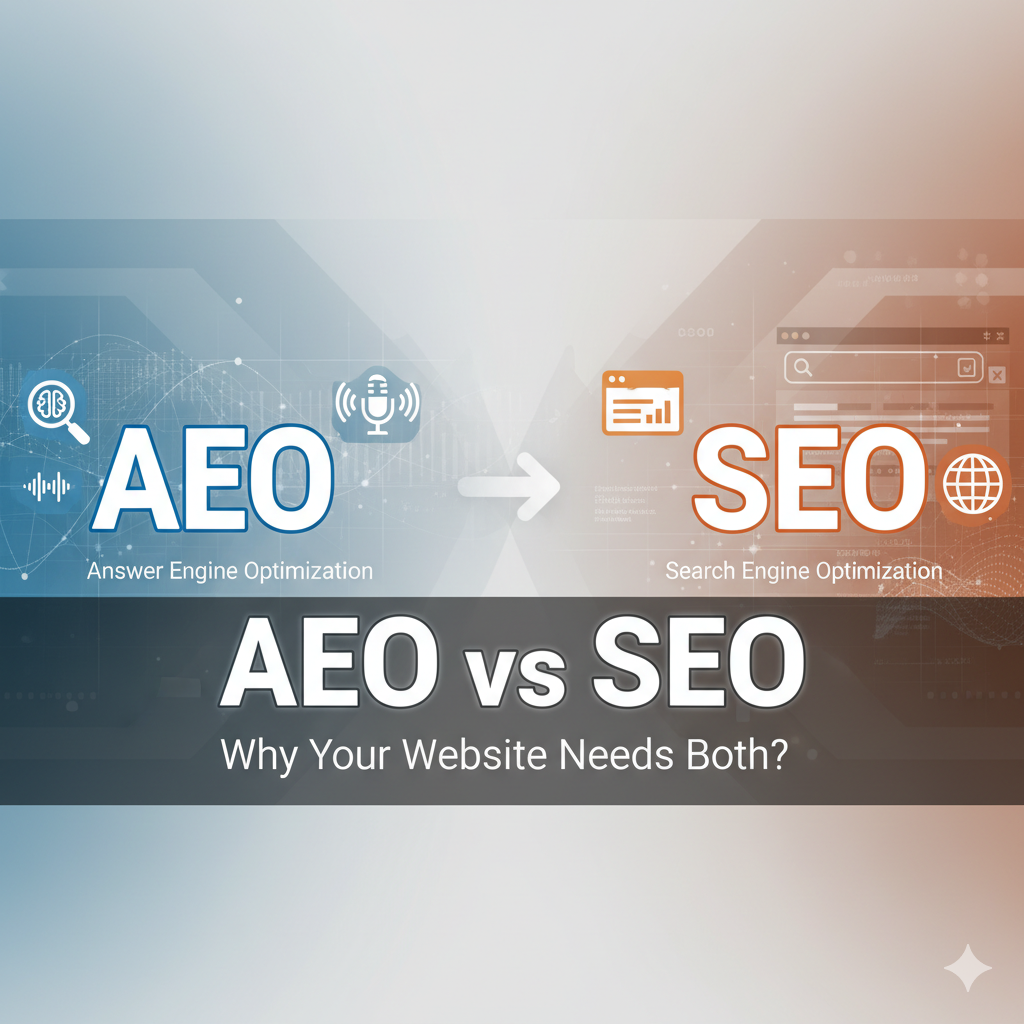
Search is changing — fast. We’re moving from keyword-based queries to AI-driven conversations.
To stay visible, your site needs both:
SEO (Search Engine Optimization) → For humans searching on Google & Bing.
AEO (Answer Engine Optimization) → For AI assistants, voice search, and chat-based platforms.
What is SEO?
Optimizes your site to rank higher in search results.
Focus areas:
- Keyword research & placement
- Backlinks & authority building
- Meta tags & descriptions
- Page speed & mobile-friendliness
- Fresh, relevant content
What is AEO?
Optimizes your site so AI systems understand and surface your content as direct answers.
Focus areas:
- Structured data (Schema.org, JSON-LD)
- Semantic HTML & accessibility
- Clear, natural language
- AI preview & voice compatibility
- Entity recognition & modular answers
SEO vs AEO — Key Differences
| Feature | SEO | AEO |
| Audience | Human searchers | AI & voice assistants |
| Focus | Keywords, backlinks, SERP ranking | Structured data, semantic clarity |
| Output | Search listings | Direct answers & AI previews |
| Tools | Keyword planners, SERP trackers | Schema validators, AI audits |
| Style | Keyword-rich | Conversational & answer-ready |
Why You Need Both
SEO and AEO work together:
SEO brings human traffic
AEO brings AI-driven visibility
SEO builds authority
AEO builds clarity
AEOVISTA bridges the gap — auditing your site for AEO signals while supporting your SEO.
Example
You post “How to Optimize Your Website for AI Search”:
- SEO: Ranks on Google for typed searches
- AEO: Appears as a direct answer on ChatGPT, Gemini, Siri
How AEOVISTA Helps
- Checks structured data & semantic HTML (AEO)
- Evaluates crawlability, mobile speed, content clarity (SEO)
- Runs AI preview simulations
- Gives actionable steps for both strategies